
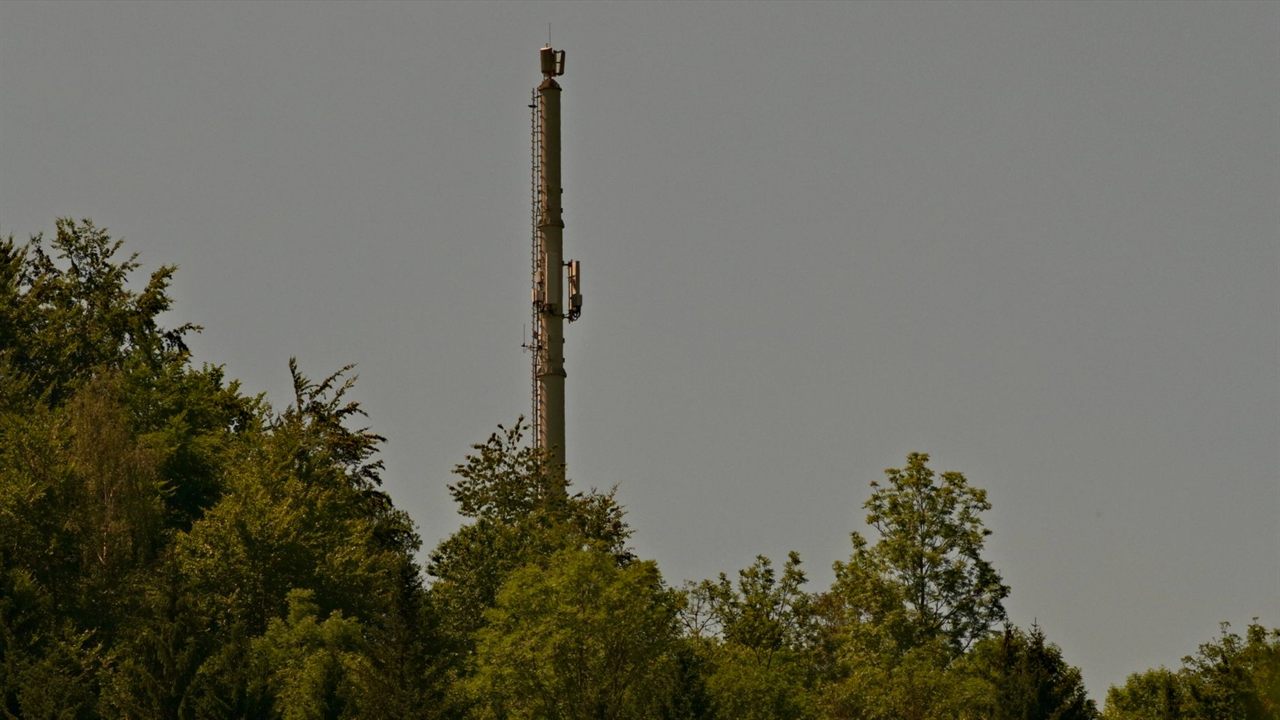
A tower that is 20 ft too short leaves customers behind a tree line; one that is 60 ft too tall costs more, needs more paperwork and may still miss the houses in the next hollow. WISP tower height is not a rule of thumb. It is a sum: the tallest obstacle on the path, plus the bulge of the Earth, plus enough clearance around the beam, plus room for trees to grow. This guide works that sum with real numbers.
How tall should a WISP tower be?
Tall enough that the line from the tower antenna to each customer antenna clears the highest obstacle on the path by the Earth bulge plus at least 60 percent of the first Fresnel zone, with an allowance for tree growth. Over 60 ft trees at 5.8 GHz that is about 83 ft for a 5 mile link and about 101 ft for 10 miles.
What sets WISP tower height
Radio links need more than a clear view. The beam needs space around it, and over long paths the ground itself rises between the two ends. Tower height for line of sight therefore adds four layers at the worst point on the path:
- Obstacle height: the tallest trees, buildings or ridge between the tower and the customer.
- Earth bulge: how far the curved Earth lifts that obstacle toward the beam.
- Fresnel zone clearance: the open space the signal needs around the direct line.
- Growth allowance: trees and buildings that will be taller during the tower’s life.
The numbers below assume flat terrain, both ends at the same ground elevation, the obstacle at mid-path and a 5.8 GHz link. Real paths need a profile drawn from terrain data, but the method is the same.

Earth curvature: a worked calculation
Radio waves bend slightly with the atmosphere, so planners use an effective Earth radius of 4/3 the true radius, the default in the ITU method our point to point wireless link planning guide uses. With that assumption, the bulge in feet at a point d1 miles from one end and d2 miles from the other is d1 x d2 / 2.
- 5 mile link, at mid-path: 2.5 x 2.5 / 2 = about 3 ft.
- 10 mile link: 5 x 5 / 2 = 12.5 ft.
- 15 mile link: 7.5 x 7.5 / 2 = about 28 ft.
Bulge grows with the square of distance, which is why it barely matters on a short hop and dominates a long one.

Fresnel zone clearance at 5.8 GHz
The point to point guide gives the first Fresnel zone formula from ITU-R P.530 and the 60 percent clearance rule, so we will not repeat the derivation. Converted to feet and miles, the radius is 72.0 x the square root of (d1 x d2 / (f x D)), with f in GHz and D the path length. At mid-path and 5.8 GHz:
- 5 miles: radius about 33 ft, 60 percent about 20 ft.
- 10 miles: radius about 47 ft, 60 percent about 28 ft.
The same guide notes that ITU planning starts from full first zone clearance where local data is lacking. On the 10 mile path that adds about 19 ft to the answer below.

Putting it together: tower height for line of sight
Add the layers over an assumed 60 ft tree line at mid-path. For a 10 mile link: 60 + 12.5 + 28.4 = about 101 ft at both ends, or about 120 ft with full first zone clearance.
| Path length | Earth bulge | 60% Fresnel | Antenna height |
|---|---|---|---|
| 3 miles | 1 ft | 16 ft | About 77 ft |
| 5 miles | 3 ft | 20 ft | About 83 ft |
| 10 miles | 12.5 ft | 28 ft | About 101 ft |
| 15 miles | 28 ft | 35 ft | About 123 ft |
These are antenna heights, not tower heights. Add the distance from the antenna centre to the tower top, and any extra a growth allowance needs.
The customer end decides more than the tower
Trees near the customer are the hardest case, because the beam is low there. Take a 3 mile path with the customer antenna at 25 ft and a 50 ft tree line half a mile from the house. At that point the bulge is under 1 ft and 60 percent of the Fresnel zone is about 12 ft, so the beam must pass 62 ft.
The line from a 25 ft customer antenna rises only one sixth of the tower’s extra height by that point, so the tower would need about 248 ft. Raising the customer antenna to 35 ft cuts that to about 198 ft. Raising the customer antenna, or serving the house from another direction, can solve what tower height cannot.
Foliage and tree growth
Survey with the leaves on. A path that looks clear in winter can fail in summer, and wet foliage can absorb more signal. Treat trees as obstacles at 5 GHz, not as something the signal passes through.
- Measure the tallest trees on the path, not the average canopy.
- Choose a growth allowance for the tower’s planned life and add it to the obstacle height.
- Leave room on the tower for antennas to move higher later.
One tall tower or several hops
Height buys reach, but the table shows each extra mile costs more height than the last. Two 5 mile hops each need about 83 ft over the same trees, against about 101 ft for one 10 mile hop.
| Factor | One tall tower | Several shorter hops |
|---|---|---|
| Height per site | Greatest | Lower at each site |
| Sites to lease, power and maintain | One | Several |
| Points of failure | Fewer | More radios and links in the chain |
| Coverage of valleys and hollows | Limited by terrain shadows | Relays can look down into them |
Relays also let you choose a band per hop; see 5GHz vs 60GHz wireless bridge and licensed vs unlicensed backhaul.
Cost, permitting and FAA notice
Every added section adds steel, foundation, wind load and climbing time, and local rules may call for a zoning review as well as a building permit. Guyed vs self-supporting tower covers the structure and permit side, and radio tower grounding the site protection.
Federal notice is the hard line. Under 14 CFR 77.9, construction more than 200 ft above ground level requires notice to the FAA, and so can shorter structures near airports and heliports. The FAA Obstruction Evaluation page links the Notice Criteria Tool, which lists the minimum conditions for filing; check every site with it.
Where to find towers and WISP hardware
The wireless tower category lists tower sections and hardware, and the Broadband - WiFi division lists radios and antennas; sector vs omni antenna helps choose the access point antenna. For pricing and availability, ask your sales representative through the Bursma contact page, or open a Bursma dealer account.
Frequently asked questions
How tall does a wireless internet tower need to be?
Tall enough to clear the worst obstacle on each path by the Earth bulge plus 60 percent of the first Fresnel zone, with a growth allowance. Over 60 ft trees at 5.8 GHz, that is roughly 77 to 123 ft for 3 to 15 mile links on flat ground.
How much does Earth curvature matter for a WISP link?
Little on short links and a lot on long ones. With the 4/3 Earth assumption, the mid-path bulge is about 3 ft at 5 miles and about 28 ft at 15 miles.
Do trees block 5 GHz wireless internet?
Plan as if they do. Leaves absorb and scatter 5 GHz signals, and wet summer foliage is worse, so clear the trees rather than shooting through them.
Does a WISP tower need FAA approval?
Notice is required for structures more than 200 ft above ground level and for some shorter ones near airports and heliports. Run the FAA Notice Criteria Tool for every site.