
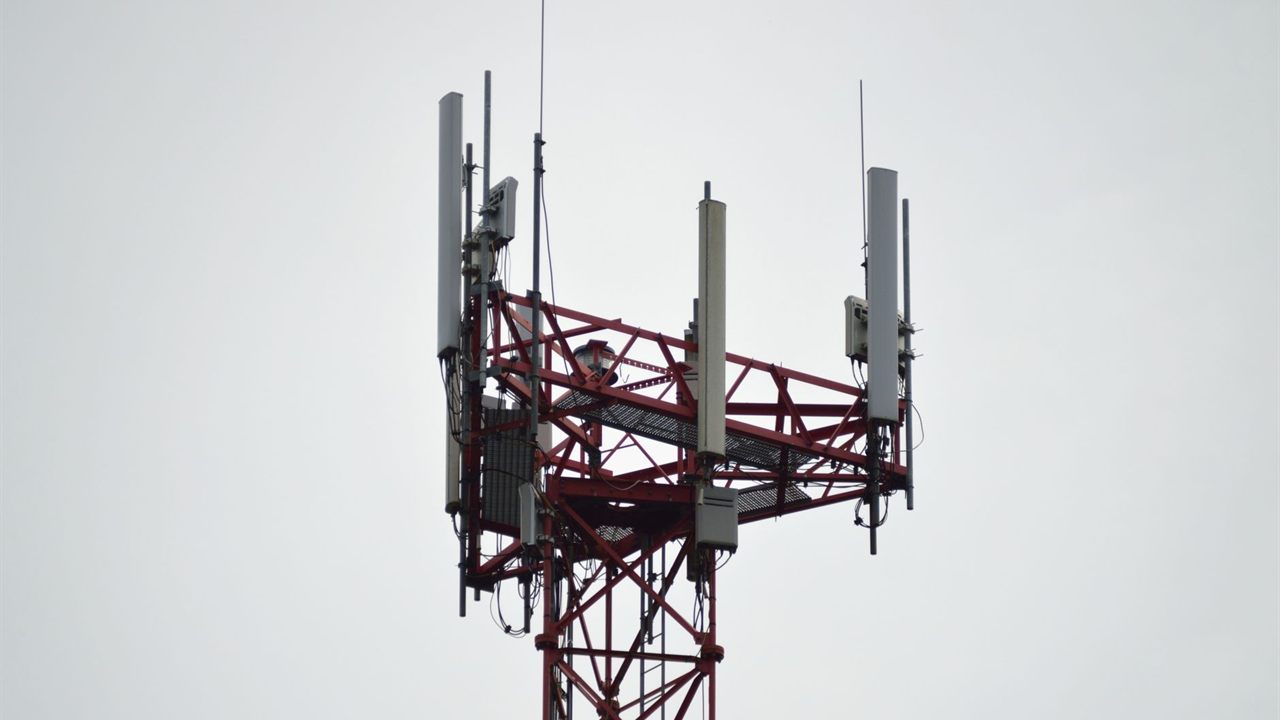
Every point to multipoint access site starts with the same question: one omnidirectional antenna that covers the whole circle, or several sector antennas that each cover a slice of it. The sector vs omni antenna choice decides how far the site reaches, how much noise it hears, how many subscribers it can carry and how much hardware goes up the tower. This guide walks through the trade-offs the way a WISP plans a new access point.
Sector vs omni antenna: which should a WISP use?
Use an omni for a small cluster of subscribers spread all around a short pole, where one radio can carry the load. Use sectors for most growing sites: each sector focuses gain on its slice, hears less noise from elsewhere and gets its own radio and channel, so capacity grows with every sector you add.

Sector vs omni antenna compared
The table sums up typical designs. The pattern sheet of the specific antenna sets its real gain, beamwidth and front-to-back ratio.
| Factor | Omni | Sector |
|---|---|---|
| Horizontal coverage | 360 degrees from one antenna | A slice, commonly 60, 90 or 120 degrees |
| Gain | Lower, spread around the circle | Higher, focused on the slice |
| Noise and interference | Hears every direction | Hears mainly its own slice |
| Capacity | One radio shared by every subscriber | One radio and channel per sector |
| Tower hardware | One antenna, one radio | Several antennas, radios, mounts and cables |
| Best fit | Small clusters, short poles, temporary sites | Growing sites, tall towers, clients in known directions |

How an omni antenna covers a site
An omni spreads its energy evenly around the horizon, so every subscriber in range sees the same antenna no matter where they sit. That makes it the simplest point to multipoint antenna to install: no azimuths to plan, nothing to aim, and one radio to configure.
The cost of that simplicity is gain. An omni gets its gain by squeezing the pattern vertically into a flat disc, so a high-gain omni has a thin vertical beam. Installer forums report that omnis work well on short poles with nearby clients but disappoint on tall towers and hilltops, where subscribers close to the base sit below the beam.

How a sector antenna for a WISP splits the circle
A sector antenna places a reflector behind its elements, so it radiates forward into a defined arc and little to the rear. Several sectors mounted around a tower cover the full circle between them, each with its own radio. Common layouts:
- Three 120 degree sectors: the least hardware for 360 degree coverage, suited to moderate subscriber counts.
- Four 90 degree sectors: tighter beams and more gain per sector, and easier channel reuse.
- Six 60 degree sectors: dense sites where capacity matters more than hardware count.
Check how the spec sheet measures beamwidth. It is normally quoted between the half-power points, 3 dB below the peak, but some sectors are also rated at their 6 dB points, which makes the same antenna sound wider. Plan the overlap between neighbouring sectors from the actual pattern, not the headline number.

Gain, beamwidth and the FCC power ceiling
Narrowing the beam raises the gain, which is why a sector out-gains an omni in the same band. On the transmit side, though, the FCC limits how much of that gain a point to multipoint site may use.
In the 5.725 to 5.85 GHz band, 47 CFR 15.407 allows 1 W of conducted output power and requires that power to be reduced by every dB of antenna gain above 6 dBi. Only fixed point-to-point links are exempt, and the rule states that point-to-point does not include point-to-multipoint systems or omnidirectional applications. The operator, or the professional installer, is responsible for compliance.
The practical result is that an access point radiates about the same maximum power in that band whether it feeds an omni or a high-gain sector. The sector still wins on the receive side: its gain lifts the weak signals coming back from subscriber radios and rejects noise from outside its slice. Other U-NII bands carry their own limits, so check the paragraph for the band you plan to use.

Interference, capacity and channel reuse
Capacity is where sectors pull ahead. Every subscriber on an omni shares one radio’s airtime, and that radio hears every other transmitter on its channel from every direction. Split the same site into four sectors and you have four radios, each serving a quarter of the subscribers and hearing a quarter of the horizon.
Sectors also let you reuse channels. Back-to-back sectors on a single channel can work when the antennas have a strong front-to-back ratio, and alternating polarisation adds isolation. Adjacent sectors normally take different channels so their overlap does not become interference.

Point to multipoint antenna layouts that work
- Map the subscribers first. If they cluster in one or two directions, one or two sectors may cover them without lighting up empty country.
- Use an omni where it fits: a small cluster all around a short pole, a temporary site or a trial deployment.
- Set downtilt on tall towers. Tilt sectors down so the main beam lands on the subscribers rather than the horizon; variable beam sectors widen or narrow the slice to suit.
- Feed each sector its own radio. Forum reports describe splitting one radio across several sectors as a weaker result than a single omni, because the splitter loses signal.
- Plan the tower load. Each sector adds an antenna, a mount, a radio, a cable run and power. Check that the structure and its mounts are rated for it.
Sector sites usually connect back to the network over a backhaul. If that link is part of the job, read how to plan a point to point wireless link for Fresnel clearance, path loss and fade margin. For indoor coverage inside a subscriber’s building, the same omni and directional logic appears in our guide to WiFi access point placement.
Where to find WISP antennas and mounting hardware
The Bursma wireless antenna category lists both types, including a 5 GHz 16 dBi 120 degree sector antenna (UBIAM-5G16-120), a 5 GHz variable beam sector, 60 to 120 degrees (UBIAM-V5G-TI) and a 5 GHz 13 dBi dual omni antenna (UBIAMO-5G13). Access point and backhaul units are in the wireless radios category, and structures in the wireless tower sections category. For outdoor electronics, match the box to the site with our guide to NEMA enclosure ratings.
Everything sits in the Bursma broadband and WiFi division. For pricing and availability, ask your sales representative through the Bursma contact page. If you build wireless networks for a living, apply for a Bursma dealer account.
Frequently asked questions
How many sector antennas do I need for 360 degree coverage?
Three 120 degree sectors or four 90 degree sectors cover the full circle. Six 60 degree sectors suit dense sites. Allow for the real pattern width at the edges so there are no gaps between neighbouring sectors.
Is an omni antenna good for point to multipoint?
Yes, for a small group of subscribers all around a short pole. As the subscriber count grows, a single omni radio runs short of airtime and hears too much noise, and sectors become the better choice.
Does a sector antenna give more range than an omni?
Usually, because its gain is higher. In the 5.725 to 5.85 GHz band the FCC caps point to multipoint transmit power by antenna gain, so much of the advantage comes on the receive side, where the sector hears weak subscriber signals better.
Do sector antennas need downtilt?
On tall towers, often yes. Tilting the sector down puts the main beam on nearby subscribers instead of the horizon and cuts interference with distant sites. Short poles usually need little or none.