
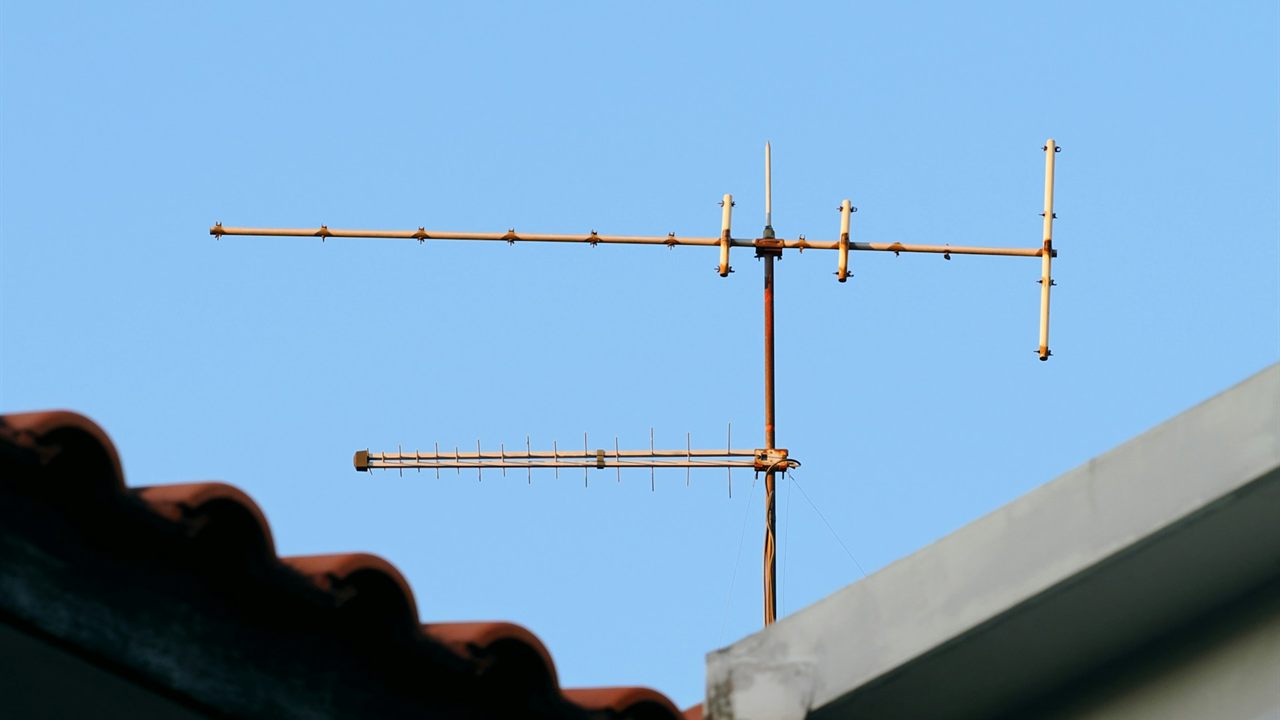
The customer wants every station in the market, and the first question on the survey is how high to mount the TV antenna. Higher usually helps, but every extra foot of mast adds wind load, coax, guy wires and sometimes a permit. This guide covers what height buys, how to judge it on site, and the limits on a tall mast.
How high should a TV antenna be mounted?
High enough that nothing close to the house blocks the path to the transmitters: usually just above the roofline and any trees or buildings on that bearing. Extra height pays when nearby obstacles sit at the antenna’s level. Once it sees over them, more mast mostly adds wind load and cable.

How high to mount TV antenna masts: start at the roofline
The useful reference point is the roof and what surrounds the house, not the ground. An antenna at or below the ridge looks through its own roof toward any transmitter on the far side, and it sits inside the layer of trees, chimneys and neighbouring roofs that scatter the signal.
Lifting the antenna just clear of that layer is usually the biggest single improvement on the job. From there, height becomes a trade:
- Leverage: wind acts at the top, so the load on the mount grows with every foot of mast.
- Cable: each extra foot of mast is another foot of downlead.
- Guys and permits: tall masts need guys and may need a permit.
The right TV antenna height is the shortest mast that gives every wanted station a clear path, with a margin for trees in full leaf.

Why TV antenna height matters: line of sight and terrain
Hills, ridges and dense buildings between the tower and the house cast signal shadows. UHF signals are generally more easily blocked by terrain and buildings than VHF, which our guide to UHF vs VHF antennas and TV channel bands explains along with element sizes.
Height also pushes back the radio horizon, but less than most people expect. On smooth earth with the common 4/3 effective earth radius assumption, the horizon distance in miles is about 1.41 times the square root of the antenna height in feet:
- 20 ft: 1.41 x 4.47 = about 6.3 miles
- 30 ft: 1.41 x 5.48 = about 7.7 miles
- 40 ft: 1.41 x 6.32 = about 8.9 miles
Doubling the height from 20 to 40 feet moves the receive horizon about 2.6 miles. The transmitter’s height matters far more: a 1,000 ft tower’s own horizon is about 44.7 miles on the same assumption. Installer forums report the same pattern: extra feet help when trees or roofs sit near the antenna’s level, and add little once it sees over them.

Survey the path before you choose an antenna mast height
Decide the height from the site, not a rule of thumb:
- Get each transmitter’s bearing and distance from a reception report for the address.
- Look along each bearing from the planned mount point. Note the ridge, chimneys, neighbouring houses, trees and rising ground.
- Allow for leaves. A winter test can pass a path that summer foliage blocks.
- Measure at two heights. Mount the antenna temporarily at the eave, scan with a signal meter, then repeat at the planned mast height.
If a station sits behind a hill the antenna will never see over, more height may not fix it. A higher gain antenna may do more, and a rotor helps when stations lie in several directions; see do I need an antenna rotor. Where roof work is ruled out entirely, the attic trade-offs are in our indoor vs outdoor TV antenna comparison.
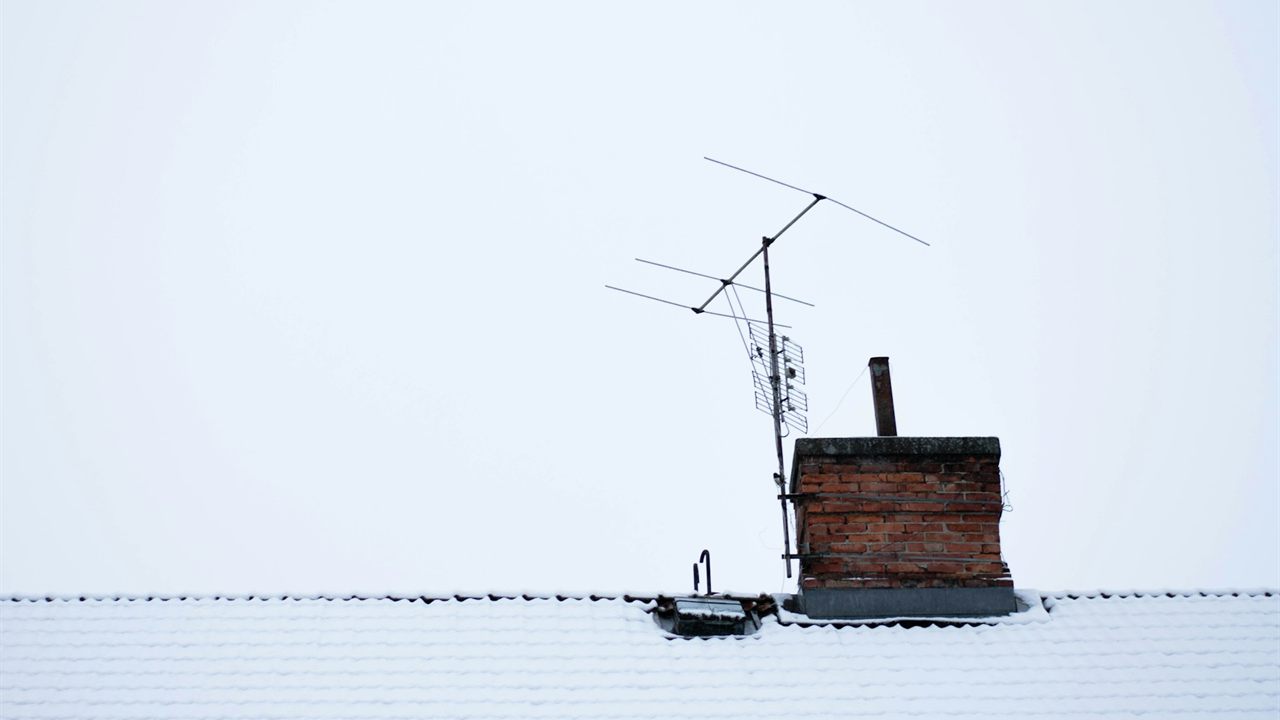
TV antenna height options compared
| Option | Height reached | Extra work | Best fit |
|---|---|---|---|
| Attic | Below the roof deck | None outdoors; the signal passes through the roof | Strong stations, roof work not allowed |
| Eave or wall mount | A short mast just past the eave | Brackets into framing, no roof holes | Clear paths over a low roofline |
| Roof tripod and mast | Ridge plus the mast above the collar | Roof lags and sealing, guys on long masts | Trees or roofs just above the ridge |
| Telescoping mast or tower | Well above the house | Guys or a tower base, often a permit | Fringe sites, tall obstructions |
The Bursma antenna mast category lists 1-1/4 and 1-1/2 inch mast sections in 5 and 10 ft lengths; match the diameter to the tripod collar and antenna clamp. For the base itself, see roof tripod vs antenna mast.

Guying a tall antenna mast
Our tripod guide gives the field rule for when a mast needs guys and how to lay them out. Taller masts add a few points:
- Follow the hardware ratings. Use the guy levels and antenna load the mast or tripod instructions specify.
- Anchor into structure. Guy anchors go into framing or proper ground anchors, never gutters, fascia or shingles.
- Keep guys clear of lines. Guy wires and anchors need the same power line clearance as the mast.
- Recheck after storms. Check guy tension, clamps and the collar after heavy wind and on service calls.
When the height the site needs is more than a roof can anchor, a freestanding or guyed tower is the safer route; our guide to guyed vs self-supporting towers compares them, and the tower category lists the sections.

Power line clearance and the fall zone
Height raises the stakes near overhead lines. The U.S. Consumer Product Safety Commission reported that between 1990 and 1998 more than 300 people were electrocuted when an antenna or pole they were holding touched a high-voltage line. Its CPSC power line safety advice is to keep the distance from an antenna or pole to the power line at least 1 1/2 times its height.
Worked example, assuming a 10 ft mast with a 5 ft antenna above it: 10 + 5 = 15 ft of hardware, and 1.5 x 15 = 22.5 ft minimum to the nearest line. Many antenna and mast instructions set a larger distance, so use whichever figure is greater.
- Federal rules at 16 CFR Part 1402 require outdoor TV antennas and supporting structures to carry a power line warning and site selection instructions.
- Look for service drops and lines added since an old antenna went up.
- Assemble on the ground, raise with a helper, and never let the mast tip toward a line.
A taller mast is also more exposed to weather and nearby strikes, so bond it before connecting the coax, as set out in how to ground a TV antenna and mast.
Antenna mast height and the FCC OTARD rule
The FCC’s Over-the-Air Reception Devices rule, 47 CFR 1.4000, limits restrictions on antennas that receive TV broadcast signals, and it names a mast supporting such an antenna among the covered devices. The protection applies on property within the exclusive use or control of the antenna user, so a shared condominium roof is usually outside it.
It is not unlimited. A restriction needed to accomplish a clearly defined, legitimate safety objective can still apply, and the FCC’s guidance allows a permit requirement for masts more than 12 feet above the roofline.
Where to find masts and mounting hardware
Mast, roof tripods for antenna masts, towers and outdoor antennas are all in the Antenna - Tower - Satellite division. For pricing and availability, ask your sales representative through the Bursma contact page. If you install for a living, open a Bursma dealer account.
Frequently asked questions
Does the height of a TV antenna matter?
Yes, mainly because it lifts the antenna clear of the roof, trees and nearby buildings. Once it sees over them, extra height adds little.
How high above the roof should a TV antenna be?
High enough to clear the ridge and any obstacle along each transmitter’s bearing, with a margin for summer leaves. If readings at the eave match the planned height, use the shorter mast.
Can a TV antenna be mounted too high?
For reception, rarely. The limits are practical: longer downlead, wind load, guying, a possible permit and more distance needed from power lines.
How far should a TV antenna be from power lines?
The CPSC advises at least 1 1/2 times the height of the antenna or pole. For a 15 ft assembly that is 22.5 ft. Follow the product’s instructions where they ask for more.