
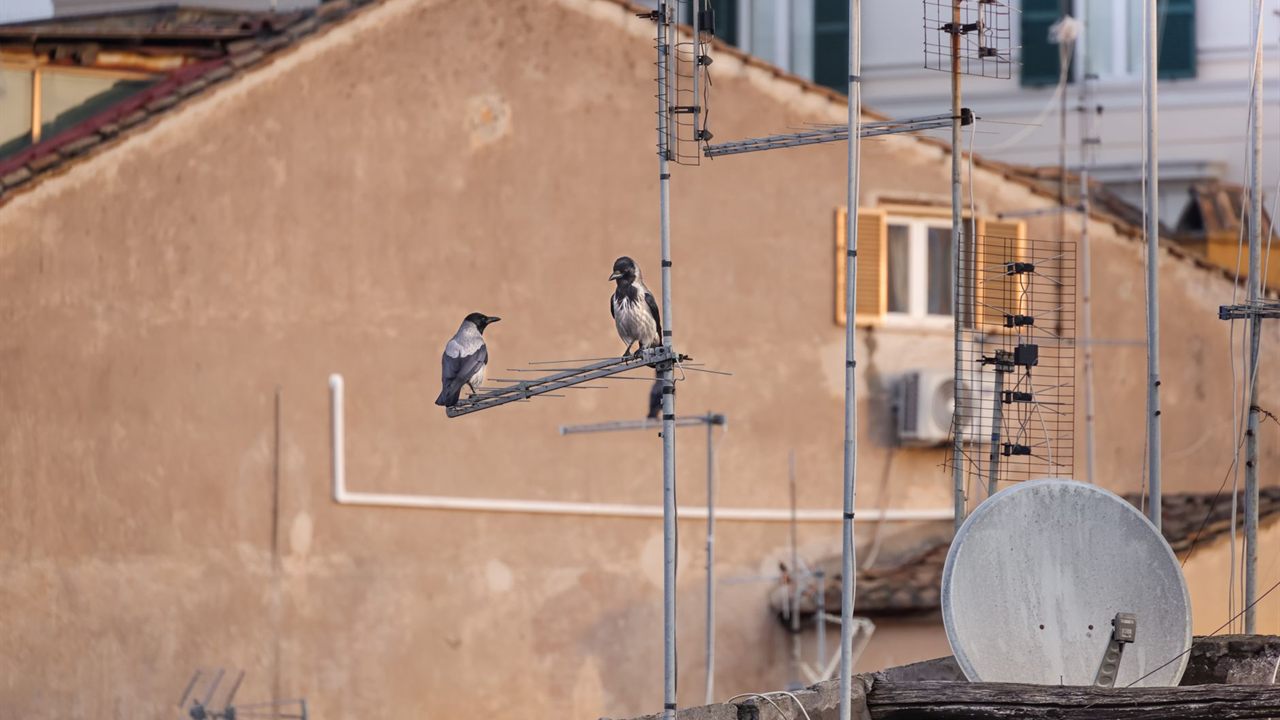
Most off-air jobs start with the same question from the customer: will a small antenna beside the TV do, or does something have to go in the attic or on the roof? The indoor vs outdoor TV antenna decision sets the labour, the parts list and how many channels the customer still has once the leaves come out. This guide gives installers a way to make that call during the site survey instead of on a second trip.
Is an indoor or outdoor TV antenna better?
An outdoor antenna is better wherever stations are distant, spread across several directions or blocked by terrain, because height and a clear path matter most. An indoor antenna is enough when transmitters are close, signals are strong and the walls are not metal or foil lined. An attic antenna sits between the two, with less loss than indoors but more than the roof.

How indoor and outdoor antennas differ
Every wall, floor and roof between the antenna and the transmitter absorbs or reflects part of the signal. An indoor antenna sits low, inside that structure, and is usually small with modest gain. An outdoor antenna sits above the roofline with a clear view of the horizon, and it is usually a larger directional array with more gain.
Height is the biggest difference, and it is built into the tools most people use to check coverage. AntennaWeb’s signal prediction tool states that its results assume an antenna installed 30 feet or more above ground level. A customer who reads a coverage map and then buys a set-top antenna is comparing two different installations.
Indoor vs outdoor TV antenna compared
The attic belongs in the comparison, because it is often the compromise a homeowner will accept when the roof is off limits.
| Factor | Indoor | Attic | Outdoor |
|---|---|---|---|
| Best fit | Close, strong stations in one direction | Moderate distance, roof work not wanted | Distant, fringe or scattered stations |
| Signal path | Through walls, windows and people | Through roof deck and gable ends | Clear view over the roofline |
| Antenna size | Small, often low gain | Medium to large | Any size, including fringe arrays |
| Weather exposure | None | None | Wind, ice and lightning |
| Installer labour | Placement and rescan | Attic mount, cable drop | Mount, mast, grounding, cable entry |
Start with a reception survey
Run the address through a prediction tool before quoting. Note each station’s distance, compass direction, predicted strength and band, because UHF, high-band VHF and low-band VHF behave differently and need different elements on the antenna.
On site, compare the prediction with reality. Hills, tree lines, nearby buildings and the house’s own construction all change what arrives at the antenna. A signal meter or a TV’s signal screen at the planned location settles the question faster than any map.
- Stations within one narrow arc: one directional antenna will do.
- Stations in two or more directions: plan a wider antenna, two antennas or a rotor.
- Any wanted station on high-band VHF: check that the antenna has VHF elements.
- Weak predicted signal: assume outdoor, and test the attic only as a fallback.
When an indoor antenna is enough
Indoor antennas work when the transmitters are close and the customer only wants the main local stations. They suit renters, condos and homes where roof work is not allowed. They also make a quick test of the address before a larger job is quoted.
Placement decides most of the result. Mount the antenna high, on or near a window or outside wall facing the transmitters, and keep it away from other electronics. Move it in small steps and rescan the TV after each move, because a few inches can win or lose a channel.
The limits are physical. High-band VHF wavelengths are long, so a compact flat antenna often struggles on those channels, and people moving through the room can make a marginal signal drop out. Bursma’s indoor TV antenna range includes amplified and omnidirectional models for these jobs.

The attic TV antenna option
An attic TV antenna keeps the hardware out of the weather, avoids a roof penetration and often satisfies a homeowners’ association. It can also carry a full-size outdoor antenna, which an indoor location cannot. The cost is signal: the roof deck, shingles and anything inside the attic all sit in the path.
Some roofs make the attic a poor choice. Foil-faced sheathing, radiant barriers and metal roofing block most of the signal, and wet shingles add loss in rain. In those houses, an outdoor mount is usually the only reliable answer.
- Check the roof and insulation for metal or foil before promising anything.
- Set the antenna up temporarily and measure every wanted station.
- Aim through a gable end facing the transmitters where you can, since that path is often clearer than the roof deck.
- Keep the antenna clear of ductwork, wiring and plumbing vents, then mount it permanently.
When to put the antenna outdoors
Go outdoors when stations are distant, when terrain or trees sit in the path, or when the customer wants every station in the market. An outdoor antenna also handles stations in different directions better, either with a broader pattern or with a rotor. Whether a rotor is worth it is covered in do I need an antenna rotor.
Bursma’s outdoor TV antennas are grouped by job: UHF only, high-band VHF and UHF, and fringe models. Choosing the mount is the next step, and roof tripod vs antenna mast compares the options. Every outdoor installation then needs proper bonding, laid out in how to ground a TV antenna.
Over the air antenna for installers: quoting the job
The antenna is only part of the signal chain. Coax length, splitters and the number of TVs decide how much signal reaches each set, whichever location the antenna ends up in.
- Use RG6 for the downlead; RG6 vs RG59 for antenna runs explains why.
- Count the splitter outputs, since every split costs signal at every TV.
- Add a preamp only when long cable or splits are the problem; see choosing an antenna preamplifier.
- Rescan every TV after the final mount, and record signal levels for later service calls.
Quoting indoor, attic and outdoor as three options lets the customer choose with real numbers in front of them. It also sets expectations if they pick the cheaper route and lose a station later.
Where to buy TV antennas and mounting hardware
Bursma Distributing sells only to dealers, installers and integrators, and has done so since 1947. Antennas, antenna rotors, roof tripods and antenna coax are all in the Antenna, Tower and Satellite division, so one order can cover the whole job.
Dealers see their own pricing and stock in Shop Online after logging in. Open a dealer account, or call the Wyoming, Michigan branch at 616-831-0080 or the Columbus, Ohio branch at 614-299-9040.
Frequently asked questions
Can an outdoor antenna be installed in the attic?
Yes, and it usually outperforms an indoor antenna in the same house. Expect less signal than the same antenna on the roof, and test it temporarily first, because foil-faced sheathing, radiant barriers and metal roofs can make the attic unworkable.
Does an indoor antenna need an amplifier?
Not always. An amplifier makes up for cable and splitter loss, but it cannot add a station the antenna does not receive. Near strong transmitters an amplifier can overload the tuner and make reception worse.
Can an indoor antenna be used outdoors?
It is not built for weather. Rain, sun and wind will shorten its life, and it still lacks the gain and VHF elements of a proper outdoor antenna.
Does NextGen TV need a different antenna?
No special antenna is needed. NextGen TV stations broadcast on the same TV bands, so the indoor, attic and outdoor trade-offs in this guide still apply.