

A steady low hum from the speakers, present even with the volume down and nothing playing, is one of the most common callbacks in residential AV. Most of the time it is a ground loop, and knowing how to fix ground loop hum comes down to finding which connection completes the loop and then breaking it safely. This guide gives the order of work, the fixes that hold up, and the one shortcut never to take.
How to fix ground loop hum?
Unplug sources one at a time until the hum stops to find the connection that closes the loop, starting with the cable TV coax. Then break the loop in the signal path: a coax isolator, a line-level audio isolator, a balanced or optical connection, or all the gear on one circuit or conditioner. Never lift or defeat the safety ground.

What a ground loop is and why it hums
Every grounded component connects to the building’s ground through its power cord. When two of them are also joined by a shielded signal cable, the shield becomes a second ground path between them. The two ground points are rarely at exactly the same voltage, so a small current flows around the loop and through the shield, and the input reads that voltage as part of the signal. In the US it sounds like a 60 Hz hum, often with a harsher buzz from its harmonics.
The voltages are tiny, which is why the hum is so stubborn. Lecture notes from Montana State University’s electrical engineering department give 316 mV as the nominal consumer line level and list shield resistances of roughly 10 to 60 ohms per kilometer for common audio cables. A worked example, assuming a 10 m cable with a 20 ohm per km shield and 1 mA of loop current: 0.2 ohm times 1 mA is 0.2 mV of noise, only about 64 dB below the signal, which is audible in a quiet room.

How to fix ground loop hum: find the loop first
Do not buy anything until you know which cable closes the loop. The test takes a few minutes and needs no tools.
- With the system on and humming, disconnect every input from the receiver or amplifier, leaving only the speakers connected.
- If the hum stays, the problem is inside the amplifier or its power, not a ground loop.
- If it stops, reconnect the sources one at a time, listening after each one.
- The cable that brings the hum back is part of the loop. Then check what that source connects to beyond the amplifier.
Start with any source that has its own outside connection: the cable TV box, an antenna feed, or a component on a different outlet. The amplifier class does not decide whether a loop forms; class D vs class AB amplifiers differ in efficiency and heat, not in this.

Subwoofer hum from cable TV
The classic case is subwoofer hum from cable TV. The electrical code requires the coax shield to be grounded where the cable enters the building, so the cable line arrives already tied to a ground point that may be far from the outlet the AV gear uses. Plug the coax into the cable box and that distant ground joins the system, and the subwoofer, with its long unbalanced cable and deep bass response, makes the hum most obvious.
To confirm it, unscrew the coax from the cable box or the wall plate with everything running. If the hum disappears, the coax shield is the second path.
The fix is a coax ground isolator, fitted indoors between the wall plate and the cable box. It passes the signal while breaking the shield connection. Two cautions apply:
- Keep the grounding block. The isolator goes inside, after the bond at the entry, never in place of it. How to ground a TV antenna explains why that bond must stay.
- Check the specification. The isolator must pass the frequencies the service uses, and many do not pass DC, so do not put one on a line that powers a preamp or a dish.
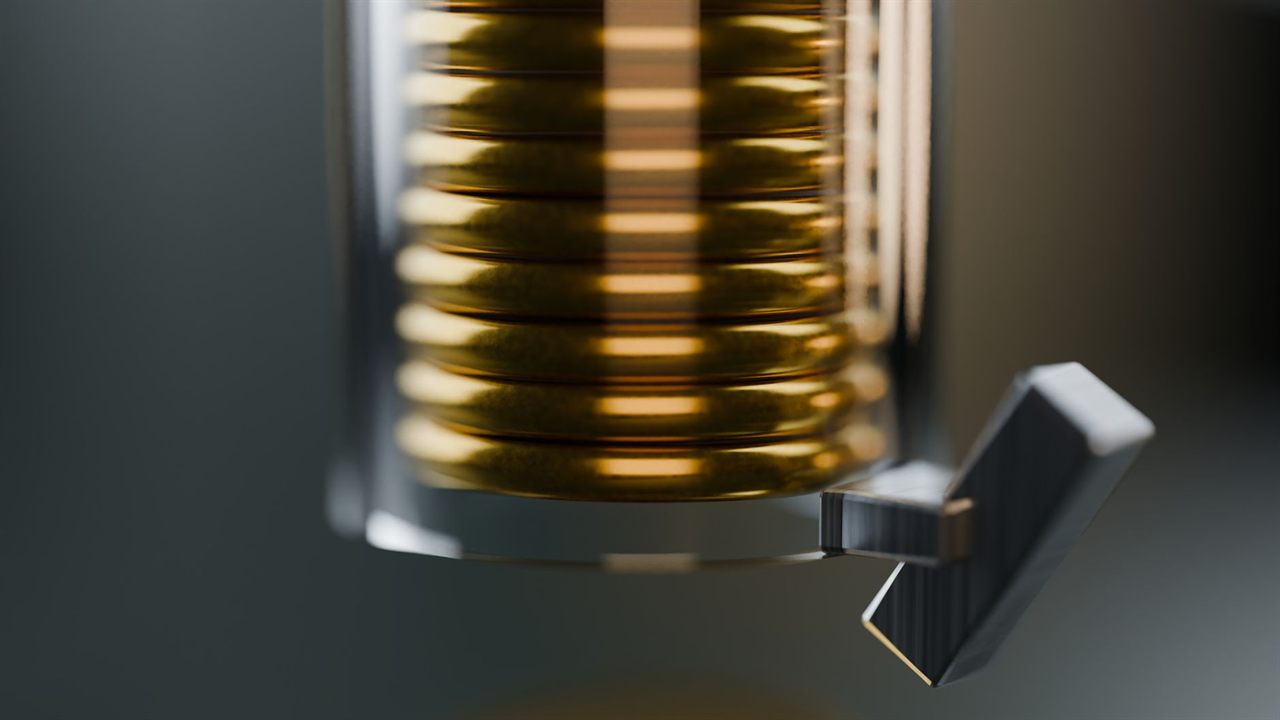
Ground loop isolator for audio connections
When the loop runs through an audio cable instead of the coax, use a ground loop isolator for audio: a small line-level transformer fitted in an RCA or 3.5 mm connection, often the subwoofer cable. The Montana State notes show the audio transformer as the standard solution, because it carries the signal across a magnetic link with no wire joining the two grounds.
Fit it at line level only, never on speaker wire. Quality varies, so check that its frequency response covers the deep bass when it sits in a subwoofer line.
When the loop runs through HDMI, an optical audio connection breaks it outright because light carries no current. Optical audio vs HDMI covers what each connection carries.
Balanced connections for longer runs
Professional and commercial gear avoids most ground loops by design. A balanced connection sends the signal on two conductors and the receiving input subtracts one from the other, so noise that appears on both is cancelled. The Montana State notes call the unbalanced connection, which most home gear uses, inherently noisy.
Where both ends offer balanced inputs and outputs, use them, especially for long runs to an amplifier in a rack. Where only one end is balanced, a transformer-based converter keeps the benefit.
One circuit, one conditioner
A loop needs two ground points at different voltages. Feeding every component in the system from the same circuit, through one strip or conditioner, puts all the power grounds at nearly the same point and often reduces the hum. A powered subwoofer plugged into a different wall outlet across the room is a common cause.
A conditioner helps here only because it gives one ground point, not because it filters hum; power conditioner vs surge protector explains what it does filter. In a rack, plan one power distribution point from the start, as in how to choose an AV equipment rack.
Never lift the safety ground
Breaking off a ground pin, using a three-to-two adapter without its ground connected, or cutting the ground wire will often stop the hum. Do not do it. The third prong is there to protect people, and the Montana State notes say engineers shall never defeat it. They also describe the danger: if the lifted device develops a fault, the fault current can flow through the audio cable instead, which can overheat and catch fire.
| Fix | Breaks the loop at | Use when | Watch for |
|---|---|---|---|
| Coax ground isolator | Cable TV shield | Hum stops when the coax is unplugged | Frequency range, DC blocking |
| Audio isolator | Line-level cable | Hum follows one RCA or sub cable | Bass response |
| Balanced connection | Cancels noise at the input | Both ends offer balanced connections | Unbalanced adapters lose the benefit |
| One circuit or conditioner | Power ground difference | Gear on different outlets | Does not fix a cable TV loop |
| Lifting the safety ground | Never use | Never | Shock and fire risk |
Where to find AV accessories
The AV accessories category lists connection hardware such as HDMI couplers and extenders, within the audio and video division. For pricing and availability on isolators and power products for a job, ask your sales representative through the Bursma contact page, or open a Bursma dealer account.
Frequently asked questions
What causes ground loop hum?
Two components grounded through their power cords and joined by a shielded cable form a loop. A small current flows through the shield, and the input hears it as a 60 Hz hum.
Why does my subwoofer hum when the cable is connected?
The cable TV coax shield is grounded at the building entry, which adds a second ground path. A coax ground isolator between the wall plate and the cable box usually fixes it.
Will a power conditioner fix ground loop hum?
Only where the loop comes from gear on different outlets, because it gives one ground point. It does not fix a loop through the cable TV coax.
Is a ground lift adapter safe?
No. Defeating the safety ground can let fault current flow through audio cables and removes shock protection. Use an isolator instead.