
The lens decides what a camera can prove. Choose too wide and a face at the far end of the drive is a few dozen pixels; choose too narrow and the person walks past the edge of the frame. The varifocal vs fixed lens camera choice is really a question of whether you know the right focal length before you mount, or need to set it on site. This guide works through the numbers so you can decide either way.
Varifocal vs fixed lens camera: which should you install?
Choose a fixed lens when the view is known and repeated, such as a doorway, corridor or small room, and the stock focal length gives enough pixels on target. Choose a varifocal lens when the distance or the scene width is uncertain, the mounting spot is far from the target, or the view must be tuned during commissioning.
Varifocal vs fixed lens camera at a glance
A fixed lens has one focal length, set at the factory, so the camera has one field of view. A varifocal lens covers a range, such as 2.8 to 12 mm, and the installer chooses the point in that range, then sets focus. Once set, both record a static view; a lens that keeps moving is the job of a PTZ, covered in PTZ vs fixed camera.
| Factor | Fixed lens | Manual varifocal | Motorized varifocal |
|---|---|---|---|
| Field of view | One, chosen at purchase | Adjustable within its range | Adjustable within its range |
| How it is set | Nothing to set | By hand at the camera | Remotely, from the camera or recorder interface |
| Focus | Factory set | By hand, after zooming | Autofocus or remote focus, per the data sheet |
| Best fit | Known, repeated views | Odd distances, few visits | High mounts, changing needs, remote tuning |

Security camera lens focal length and field of view
Focal length and sensor size together set the angle of view. For an ideal lens, the horizontal angle is 2 x arctan(sensor width / (2 x focal length)), and the scene width at a distance is that distance x sensor width / focal length. A shorter focal length gives a wider view; a longer one gives a narrower view with more detail.
The table works this out for one stated case. Assumptions: a sensor with an active image area 5.6 mm wide and a stream 2560 pixels wide (2560 x 1440). Replace both with the figures on the data sheet of the camera you are quoting.
| Focal length | Horizontal angle | Scene width at 10 m | Pixels per metre at 10 m |
|---|---|---|---|
| 2.8 mm | 90 degrees | 20.0 m | 128 |
| 4 mm | 70 degrees | 14.0 m | 183 |
| 6 mm | 50 degrees | 9.3 m | 274 |
| 8 mm | 39 degrees | 7.0 m | 366 |
| 12 mm | 26 degrees | 4.7 m | 549 |
Real lenses add distortion, especially wide ones, and some streams use only part of the sensor. Where the data sheet lists an angle of view, trust it over the formula; use the formula to compare models and to sanity check a quote.

Pixels on target: a worked example at distance
Coverage alone does not say whether the image is useful. The measure that does is pixel density at the target, in pixels per metre across the scene. The international application guide for video surveillance, IEC 62676-4, expresses image detail this way, and its 2025 second edition, previewed by the Slovak standards office, redefined the levels: seven densities from 20 to 1,500 pixels per metre replaced the 2014 edition’s six.
The density a view needs comes from the specification or the customer’s requirement, not from the lens. To show the method, take 250 pixels per metre, a value in both editions. With the same assumptions, distance = 2560 x focal length / (5.6 x 250), or about 1.83 x the focal length in metres.
- 2.8 mm: 250 pixels per metre holds out to about 5.1 m (17 ft).
- 6 mm: out to about 11.0 m (36 ft).
- 12 mm: out to about 21.9 m (72 ft).
So a camera at the corner of a building, watching a gate 20 m away, needs the long end of a varifocal range or a long fixed lens. A 2.8 mm lens sees a scene 20 x 5.6 / 2.8 = 40 m wide at that distance, so 2560 / 40 = 64 pixels per metre, roughly a quarter of the example value. Mounting height changes the distance too, which security camera mounting height covers.
When a fixed lens is the right call
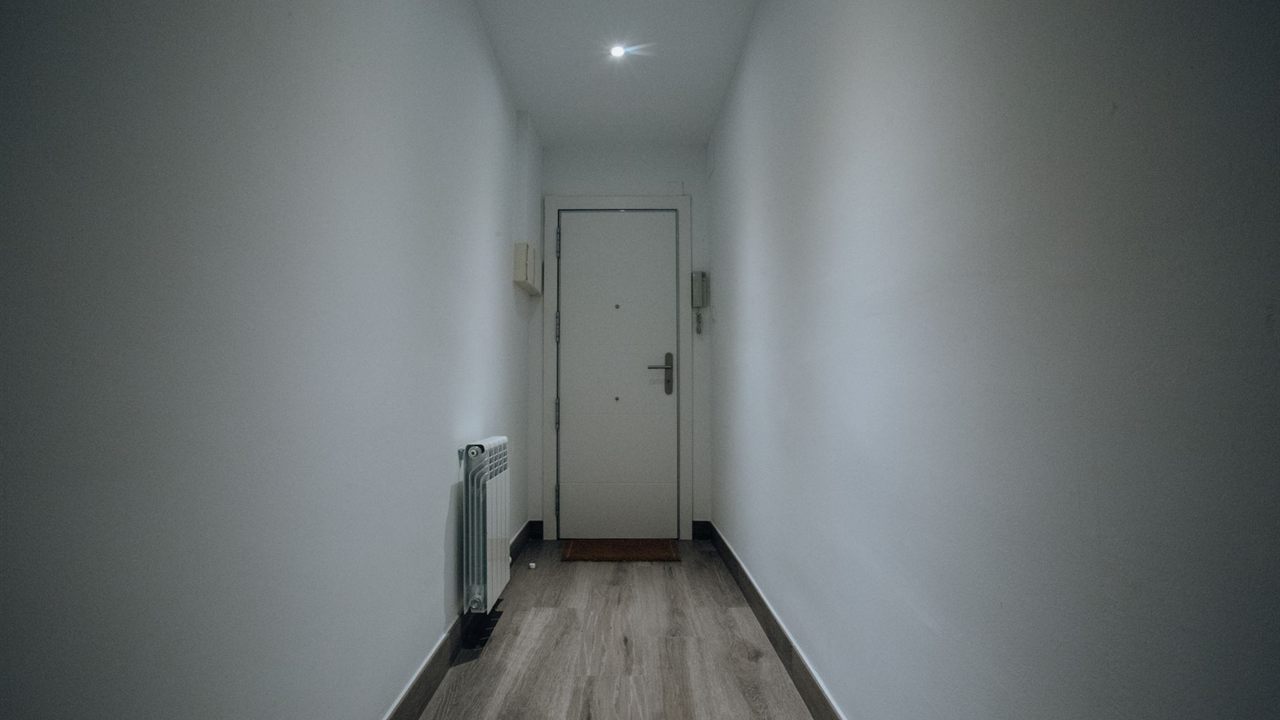
Fixed lenses suit views that repeat across a job: entry doors, corridors, small offices, stockrooms and the inside of a register area. Measure once, check the density at the distance that matters, and the same model goes on every door.
- No commissioning time: the view is what it is; aim, tilt and lock.
- Consistency: every camera of the model behaves the same, which keeps service simple.
- Fewer adjustments to drift: there is no zoom or focus setting to be knocked or forgotten.
The risk is guessing. If the site survey was rushed or the layout may change, a fixed lens that turns out too wide means a camera swap, not a setting change. Housing style is a separate choice; see turret vs dome camera.

Manual vs motorized varifocal lens
A manual varifocal has a zoom and a focus adjustment at the lens. The installer zooms to frame the scene, then refocuses, because changing focal length moves the focus. It works, but it means working at the camera with a view of the live image, often on a ladder.
A motorized varifocal lens moves the zoom and focus with small motors, set from the camera’s web interface or the recorder; see DVR vs NVR for where cameras are managed. Some add autofocus or a one-step focus command; the data sheet says which. That pays off on high or hard-to-reach mounts, when the customer wants the view changed later, and when the same model must cover very different scenes.
The motor does not make it a PTZ: once you save the setting, the view is static and recorded all the time.
Refocusing at night with infrared
Glass bends different wavelengths by slightly different amounts, so a lens brings near infrared to a focus at a slightly different point than visible light. A camera focused in daylight can look soft at night, once its day/night filter moves aside and the IR illuminators take over.
- Set the final focus at dusk or in the dark, with the IR on, because night is when the image is weakest.
- Check the daytime image afterwards; an IR-corrected lens, where the data sheet lists one, keeps both close.
- On a motorized lens, use its refocus or autofocus command after the switch, if the data sheet offers one.
A scene lit partly by IR and partly by a white light cannot be sharp everywhere; light it evenly where you can.
Where to find cameras and lenses
The security camera category lists fixed and varifocal models, and the security and surveillance division lists the recorders, power and cabling that go with them. For pricing and availability, ask your sales representative through the Bursma contact page, reach the Grand Rapids low voltage branch or the Columbus Ohio low voltage branch, or open a Bursma dealer account.
Frequently asked questions
Is a varifocal lens better than a fixed lens?
Not by itself. A varifocal lens is more flexible, so it suits uncertain distances and changing needs. A fixed lens is simpler and just as sharp when its focal length suits the view.
What does 2.8 to 12 mm mean on a camera?
It is the lens’s focal length range. At 2.8 mm the view is widest; at 12 mm it is narrowest, with the most pixels on a distant target. The angle at each end depends on the sensor size.
Why is my varifocal camera blurry at night?
Infrared light focuses at a slightly different point than visible light. Refocus with the IR illuminators on, or use the motorized lens’s refocus command if it has one.
Does a motorized varifocal lens zoom like a PTZ?
No. It is set during commissioning and then holds one view. A PTZ moves during operation and only records where it points.