

Speakers that sound full indoors can sound thin and quiet on a patio. Outside there are no walls or ceiling to reflect sound back to the listener, so outdoor speaker placement does more of the work: where the speakers sit, which way they face and how far the seats are from them. This guide covers patio and yard layouts, height and aiming, weather-rated speakers and cable, 70V for large yards and keeping the sound on your side of the fence.
Where should outdoor speakers be placed?
Place outdoor speakers close to where people sit, mounted high under an eave or on a wall and angled down toward the seating, aimed into the yard and away from neighbors. Use several speakers at moderate volume rather than one loud pair, and choose weather-rated speakers and outdoor-rated or direct burial cable.

Outdoor speaker placement starts with the listening area
Begin with a sketch of the yard rather than the house wall. Mark where people sit, eat and gather: the patio table, the lounge chairs, the fire pit, the pool deck. Those are the targets, and each speaker should serve one of them from a short distance.
The reason is how fast sound fades outdoors. A paper by Ingo Titze, hosted by the University of Utah, on singing and calling outdoors sets out the inverse square law: for every doubling of distance from a source, the level drops by about 6 dB. It also notes that outdoor venues lack the walls and roof structures that help sound carry indoors.
- A seat 20 feet from a speaker hears about 6 dB less than a seat at 10 feet.
- At 40 feet the drop is about 12 dB.
- These are open-air estimates; grass, plants and fences change them.

Patio speaker placement under eaves: height and aiming
For most patios, the eave or the wall just under it is the best mounting point. It keeps rain and direct sun off the speaker, puts it above head height and gives a short cable path back into the house.
- Mount high enough to clear heads and doors, within the height the maker’s instructions allow.
- Angle each speaker down toward the seating area with its bracket, so the seats are on axis.
- Aim into the yard and toward the house side of the patio, not out toward the lot line.
- Keep the speakers clear of gutters and downspouts, where runoff would hit them.
A covered porch with a finished ceiling is closer to a room. There, the spacing logic in our in ceiling speaker placement guide applies, using speakers rated for covered outdoor use.

Spacing pairs and zones across a yard
Outdoors, listeners move around, so the classic stereo triangle rarely holds. A guest standing beside one speaker hears mostly that side of the mix. Many outdoor zones run in mono, or use speakers that sum stereo, so every spot gets the whole song.
The doubling rule also explains why more speakers at lower volume beat one loud pair. If a single pair on the house wall has to reach a lawn seat twice as far away as the patio table, it must play about 6 dB louder to give that seat the same level, and the patio gets blasted. A second pair nearer the lawn covers it at a comfortable volume.
| Mounting | Best for | Main strength | Watch for |
|---|---|---|---|
| Under the eave | Patios next to the house | Sheltered, short cable run | Coverage ends a short way into the yard |
| Exposed wall | Decks with no overhang | Easy to aim | Needs a speaker rated for full exposure |
| Landscape satellites | Gardens and lawns | Sound comes from the yard, not the house | Buried cable, mowers and trimmers |
| 70V distributed | Large yards and many speakers | One amplifier, long runs, set taps per speaker | Transformer speakers and 70V amplifier |

Landscape speakers in beds and borders
Landscape speakers sit on stakes in planting beds around the edge of a lawn or garden, each one low and pointed inward. Because each speaker covers a small area, the sound feels even across the space and does not need to be loud anywhere.
- Set them in beds and borders, out of mower and trimmer paths.
- Point them toward the middle of the space, never outward toward a fence.
- A buried subwoofer in a bed can fill out the low end; follow its maker’s placement notes.
- Leave cable slack at each speaker so it can be moved as the plants grow.
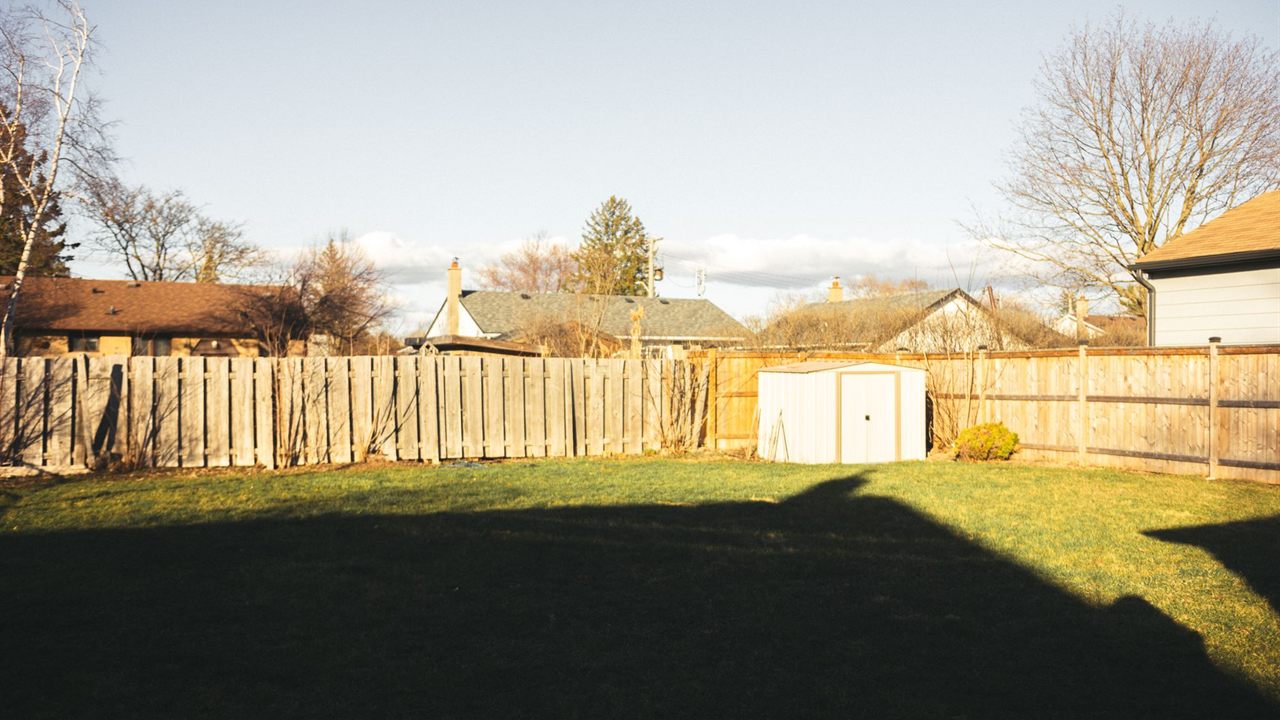
Keeping the sound off the neighbors’ side
Placement is the best noise control. Use the same doubling rule: a neighbor’s patio 80 feet from a speaker is three doublings farther than a seat at 10 feet, roughly 18 dB quieter in open air, before a fence or the house blocks anything. Aiming the speaker away puts that patio off axis as well.
- Mount on the house and aim away from shared lot lines.
- Keep speakers off fences and walls that face a neighbor’s yard.
- Use a wall-mounted volume control so guests turn it down, not up.
Noise rules are local. The EPA’s noise pollution overview states that primary responsibility for noise was transferred to state and local governments in 1981, so check the city or county noise ordinance and any HOA rules before the system goes in.
Weather-rated speakers and outdoor cable
Outdoor speakers are built for moisture, sun and temperature swings that would ruin an indoor model, but ratings differ. Some are rated only for covered locations, others for full exposure. Read the maker’s rating and installation notes, and mount the speaker the way they say, often with the drain or port facing down.
Cable needs the same care. Use direct burial speaker cable for runs in the ground, or outdoor-rated cable in conduit, and cable rated for sunlight where it runs along the eave. Call 811 before digging so buried utilities are marked, and keep splices in weatherproof boxes above grade. Size the conductors with our speaker wire gauge guide.
When a large yard needs 70V
A pool deck, a long lawn or a commercial patio can need more speakers than an 8 ohm amplifier can drive over long runs. A constant voltage system lets one amplifier feed many speakers, each set to its own level with a transformer tap. Our 70V vs 8 ohm speakers guide explains how to choose and size it.
For a house, the outdoor zone usually starts at the central rack with the rest of the system; see whole house audio wiring, and use impedance matching volume controls where several pairs share one amplifier channel.
Where to find outdoor speakers and amplifiers
The Bursma speakers category lists in-ceiling, in-wall and outdoor speaker pairs, the amplifiers category lists amps to drive them, and the volume controls category lists wall controls, all in the audio and video division. For ordering, ask your sales representative through the Bursma contact page, or open a Bursma dealer account.
Frequently asked questions
Should outdoor speakers face the house?
Mounted on the house, they face the yard. Aim them down toward the seats and away from the lot lines. In a landscape layout, speakers around the edge point inward toward the listening area.
How far apart should outdoor speakers be?
Space them by the areas they serve, not a fixed distance. Each seat should be close to a speaker, because the level drops about 6 dB each time the distance doubles outdoors.
Can you bury regular speaker wire?
No. Use cable rated for direct burial, or outdoor-rated cable in conduit. Call 811 before digging.
Can outdoor speakers stay out in winter?
Speakers rated for full outdoor exposure are built to stay mounted year round. Check the maker’s temperature and exposure rating, and keep them out of runoff from gutters.