

The music sounds fine, but the knob on the wall hums along with it, or the ceiling speakers buzz whenever someone dims the lights. In wall volume control buzzing is a common callback on distributed audio jobs, and the fix depends on one question: is the noise coming from the control itself or out of the speakers? This guide works through both, in the order to check them on site.
What causes in wall volume control buzzing?
In wall volume control buzzing usually comes from the control’s transformer vibrating with loud bass, a loose faceplate or bracket, or a multiplier setting that overdrives it. If the buzz comes out of the speakers instead, look for a dimmer or line voltage sharing the box or the cable run, the wrong type of control, or an overloaded amplifier.

In wall volume control buzzing: find the source first
Stand at the wall with music playing at the level that causes the complaint. Then listen to the control and to the speakers separately.
- The control itself buzzes: you can hear it at the wall plate, it follows the music, and it is loudest on bass. That is mechanical noise, covered in the next three sections.
- The speakers buzz: the noise comes out of the drivers, often with nothing playing, and may change when lights are switched or dimmed. That is electrical noise on the speaker line.
- The hum is everywhere: every zone hums, even with the amplifier’s inputs at idle. That usually points upstream of the controls, to a ground loop. Our guide to fixing ground loop hum covers that case.

Volume control vibration noise from the transformer
Most impedance matching controls are built around an autotransformer: a tapped winding on a laminated iron core. Our impedance matching volume control guide explains how the taps work. That core is also the usual source of volume control vibration noise.
Iron changes length slightly as it is magnetized. Georgia State University’s HyperPhysics page on magnetostriction explains that this effect is behind transformer hum: the core’s length change peaks twice per cycle, which is why mains transformers hum at 120 Hz in the US. In a volume control, the drive is the music, so the core flexes with the signal. Loud, low bass moves the most energy through it, and any loose lamination or winding turns that small movement into an audible buzz.
Installer forums report the same pattern: a control that is silent at background levels starts to vibrate as the zone is turned up, especially on bass-heavy content.
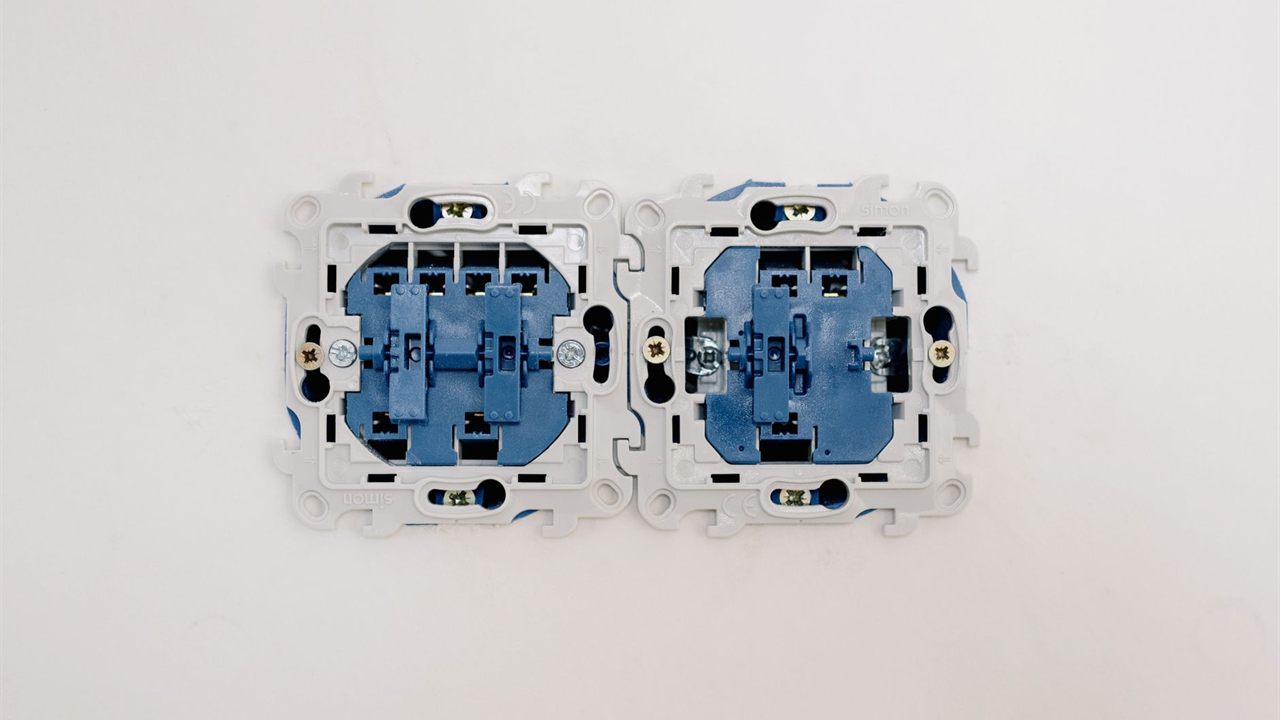
Check the impedance multiplier setting
The multiplier jumper or switch decides how much signal and current the control’s transformer handles at its top steps. Forum replies on buzzing controls point to the setting first, because the noise changes with it.
- Count the speaker pairs on the amplifier channel again.
- Confirm every control on that amplifier uses the same setting, as the matching guide sets out.
- If one control buzzes on a low setting while the others are higher, set it to match the rest and listen again.
- Check the control’s power rating against the amplifier’s output per channel. A control run beyond its rating is the likeliest to buzz.
A higher setting plays quieter for the same amplifier level, so a client may simply turn the amplifier up. Retest at the level they actually use.

Loose faceplates, brackets and back boxes
A transformer that vibrates slightly is much louder when it is fixed to something that rattles. Check the mechanical side before replacing anything:
- Faceplate and knob: tighten the plate screws and the knob set screw. A loose decorator plate buzzes against the control’s frame.
- Mounting: make sure the control is held firmly by its box or low-voltage mounting bracket, and that the bracket is tight to the drywall.
- Wires: push the speaker conductors back so they do not touch the plate. Stiff wire folded behind a control can press on it and transmit vibration.
- Cavity: an empty stud bay acts like a drum. Seat the control firmly before deciding the part is faulty.
If a firmly mounted control still buzzes at moderate levels with the correct setting, swap it. Forum reports describe different controls in the same location buzzing very differently, so a replacement is a fair test.
| Symptom | Likely cause | Quick test | Fix |
|---|---|---|---|
| Control hums with loud bass | Transformer core vibration | Turn the zone down a few steps | Correct setting, firm mounting, or swap |
| Rattle at the wall plate | Loose plate, knob or bracket | Press on the plate while playing | Tighten and reseat |
| Speakers buzz when lights dim | Dimmer noise on the speaker run | Set the dimmer to full or off | Separate box and route, or change dimmer |
| Sound only on the last steps | 70V control on an 8 ohm system | Read the control’s label | Use the matching control type |
| Buzz in every zone at idle | Ground loop upstream | Unplug amplifier inputs | Follow the ground loop steps |

Speaker buzz near a dimmer or line voltage
When the buzz comes out of the speakers and changes with the lights, a dimmer is the usual suspect. A phase-cut dimmer switches the current on partway through each half of the AC waveform; our smart dimmer vs smart switch guide explains forward and reverse phase. Those sharp edges can couple into speaker wire that runs beside them.
Speaker buzz near a dimmer usually traces to one of these:
- A shared box: the volume control sits in the same multi-gang box as a dimmer or switch. Class 2 speaker wiring and power conductors need to be separated in a shared box, with a barrier or separate compartments, so the control belongs in its own box or a divided section.
- A shared run: speaker cable strapped alongside the lighting circuit through the same bored holes. Re-route it, keep distance, and cross power at right angles.
- The dimmer itself: test with the dimmer at full and at off. If the buzz stops, try the dimmer’s other dimming mode where it offers one, or a different dimmer.
Installer forum threads describe ceiling speakers that hum with the light on and go quiet with it off, even before the speakers were connected, which points at the house wiring rather than the audio gear.
Wrong control type or an overloaded amplifier
Two other faults show up as distortion or buzz at the control. A 70V attenuator on an 8 ohm amplifier output gives little sound until the last steps and can misbehave; 70V vs 8 ohm speakers explains the difference, and the controls are not interchangeable.
An amplifier pushed into clipping also produces a harsh buzz on peaks, and a load below its rating can make it shut down. If zones cut out as well as buzz, see why an amplifier goes into protect mode, and compare protection methods in speaker selector vs volume control.
Where to find volume controls
The wall volume controls category sits in the Audio and Video division with speakers and amplifiers. For pricing and availability, ask your sales representative through the Bursma contact page, call the Columbus, OH branch, or open a Bursma dealer account.
Frequently asked questions
Is it normal for an in-wall volume control to hum?
A faint hum from a transformer-based control at high volume on heavy bass is not unusual. Loud buzzing at normal levels is not normal: check the setting, the mounting and the power rating.
Can a dimmer cause my speakers to buzz?
Yes. A phase-cut dimmer can couple noise into speaker wire that shares its box or runs beside its wiring. Separate the two and test with the dimmer at full and off.
Does the impedance setting affect volume control noise?
It can. The setting changes what the transformer handles at its top steps, so a mismatched or overdriven control is more likely to buzz.
Will a ground loop isolator stop volume control buzz?
Not if the buzz is mechanical or comes from a dimmer. An isolator only helps when line-level hum enters through an interconnect upstream of the amplifier.